
Business Setup


Setting up an enterprise in the United Arab Emirates is an extraordinary strategic move, yet the process often presents unexpected hurdles. We have guided countless international entrepreneurs through the labyrinth of Dubai trade licences, corporate registries, and banking compliance. When we established our first commercial venture here, we discovered very quickly that success does not depend on buying the cheapest promotional package advertised on social media. It depends on aligning your corporate jurisdiction with your day to day trading reality, your target clients, and your operational banking needs.
Every week, founders arrive on our doorstep frustrated after purchasing a budget package from a distant northern emirate or an unsuitable offshore registry, only to realise they cannot secure a corporate bank account or trade legally with mainland firms. The journey demands a methodical, clear headed approach. In this comprehensive guide, we share our direct operational experience, walking you through every critical stage of establishing and expanding a resilient enterprise in Dubai.
Demystifying Corporate Jurisdictions in the United Arab Emirates
The fundamental crossroad every founder faces is the choice between mainland, a free zone, and an offshore registry. We frequently see business leaders make this determination based entirely on initial formation costs. That is an expensive mistake.
Mainland entities operate directly under the regulatory umbrella of the Dubai Department of Economy and Tourism (DET). If your revenue model relies on supplying goods or delivering services directly to the local United Arab Emirates market, opening a physical retail boutique, bidding on municipal infrastructure contracts, or leasing commercial property across the emirate, mainland is your natural home. Under updated federal legislation, full foreign ownership is permitted across thousands of commercial and industrial activities without needing a local Emirati shareholder to hold fifty one percent of the equity.
Free zones operate under independent regulatory jurisdictions, offering distinct ecosystems tailored to specific sectors such as commodities, logistics, finance, media, and technology. Authorities like the Dubai Multi Commodities Centre (DMCC), Dubai International Financial Centre (DIFC), and Dubai Silicon Oasis (DSO) provide modern facilities, defined customs procedures, and single window processing for company registration and immigration. However, a free zone licence comes with geographical constraints. Historically, direct retail or service supply into the mainland domestic market required a local commercial agent or a dual licence. Recent regulatory updates under Dubai Executive Council Resolution No. 11 have established a clearer mechanism for eligible free zone companies to open direct mainland branches without forming entirely new entities.
Offshore jurisdictions such as JAFZA Offshore or RAK International Corporate Centre (RAK ICC) serve holding purposes rather than active commercial trading. We utilise offshore vehicles primarily for holding real estate assets, shielding intellectual property, or orchestrating regional joint ventures. Offshore formations do not issue local employment visas, nor do they permit regular commercial premises in the city.
Selecting the Precise Commercial Activity and Licence Category
Every trade licence in Dubai is anchored to defined economic activities. Selecting your activity is not a casual administrative formality; it sets your regulatory path, your permitted operations, and your compliance exposure.
A commercial licence applies to trading enterprises, encompassing import, export, warehousing, distribution, and general retail. A professional licence governs individual consulting, media production, technical services, software engineering, and artisan businesses where human intellectual expertise represents the primary asset. Industrial licences cover manufacturing, processing, and assembly operations, demanding dedicated industrial warehouses, civil defence clearances, and municipal environmental permits.
We always urge founders to audit their commercial activities before submitting a single application. If you intend to invoice a client for technology infrastructure and also provide ongoing strategic advice, you must combine those specific operational codes on your licence. Banks scrutinise your activity codes alongside your business plan, website, customer invoices, and actual ledger transactions. Any noticeable divergence between your trade licence description and your incoming funds can trigger anti money laundering alerts, account freezes, or requests for extensive transaction validation.
Regulated business activities demand advance clearances from relevant government bodies before the licensing authority can issue your corporate charter:
- Healthcare practices, clinics, and medical consultancy require approval from the Dubai Health Authority (DHA).
- Educational academies, training institutes, and vocational centres require approval from the Knowledge and Human Development Authority (KHDA).
- Real estate brokerage, property management, and development require accreditation through the Real Estate Regulatory Agency (RERA).
- Financial advisory, investment management, and custody services within financial hubs require authorization from the Dubai Financial Services Authority (DFSA).
- Passenger transport, freight forwarding, and commercial logistics require approval from the Roads and Transport Authority (RTA).
The Step by Step Incorporation Sequence
Navigating the formal registration steps requires meticulous coordination. While digital initiatives have accelerated the timeline, following the proper operational order prevents procedural rejections.
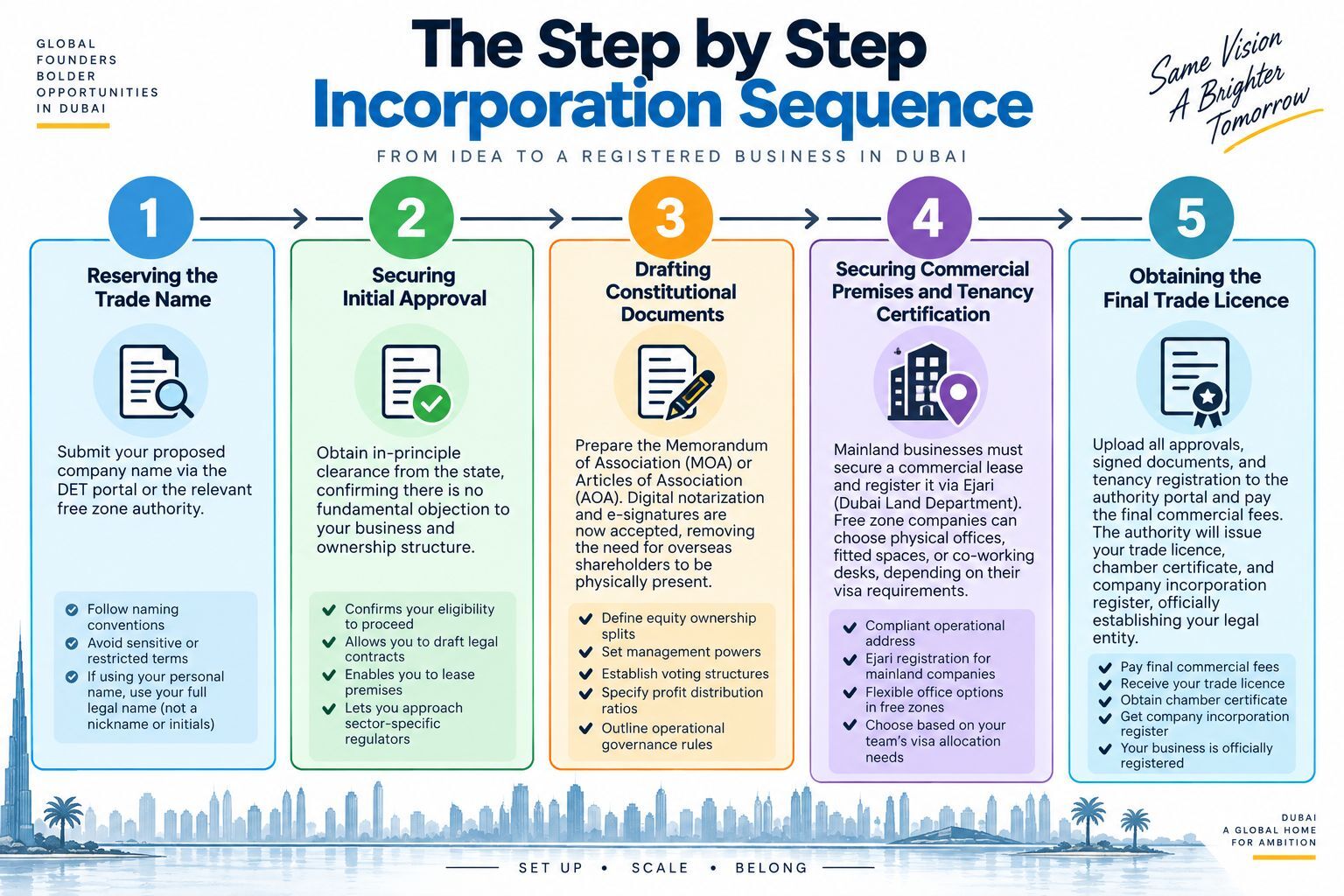
1. Reserving the Trade Name
We begin by submitting the proposed corporate name via the DET portal or the relevant free zone authority. The name must adhere to strict naming conventions. It cannot include blasphemous terms, politically sensitive words, or names of governing monarchs and global organizations without exceptional consent. If you incorporate your own personal name, it must reflect your full legal name rather than a casual nickname or initials.
2. Securing Initial Approval
Initial approval represents an in principle clearance from the state, acknowledging that the government raises no fundamental objection to your planned enterprise and ownership framework. It confirms your eligibility to move forward with drafting legal contracts, leasing premises, and approaching sector specific regulators.
3. Drafting Constitutional Documents
You must formulate the Memorandum of Association (MOA) or Articles of Association (AOA). Modern corporate legal frameworks allow electronic notarization and digital signatures, eliminating the legacy requirement for all overseas shareholders to attend a public notary in person. The document must define equity ownership splits, management powers, voting structures, profit distribution ratios, and operational governance rules.
4. Securing Commercial Premises and Tenancy Certification
Mainland enterprises must secure an operational address compliant with their chosen activities. This requires a commercial lease registered via the Ejari electronic registration system administered by the Dubai Land Department. Free zone entrants may select physical offices, fitted commercial spaces, or co working desk agreements, depending on the visa allocation quota they require for their team.
5. Obtaining the Final Trade Licence
Once external approvals, signed constitutional documents, and tenancy registrations are uploaded to the authority portal, the final commercial fees are paid. The authority issues your trade licence, formal corporate chamber certificate, and company incorporation register, marking the official birth of your legal entity.
Contact Us Today to Get Started
Our team is ready to help you navigate the Dubai office market and find the perfect home for your business.
- Mobile/WhatsApp: +971 4 253 8800
- Official Website: [www.bisdesk.com]
Understanding the True Financial Commitment and Hidden Costs
Founders often find themselves caught out by hidden operational fees that surface after paying an initial licensing invoice. An initial quote of twelve thousand dirhams for a paper licence rarely reflects the true operational capital needed to trade smoothly.
A realistic initial budget must encompass multiple compulsory elements:
- Trade Licence Issuance: The primary regulatory fee ranges between 12,000 AED and 50,000 AED annually, depending on jurisdiction, activity risk profile, and authority tiers.
- Establishment Card: An immigration requirement costing between 1,800 AED and 2,500 AED, renewed every one to three years, which unlocks your ability to sponsor visas.
- Tenancy and Municipal Charges: An Ejari registered commercial office generally commands from 25,000 AED upward annually, plus municipal market fees typically assessed at five percent of the annual lease value for commercial premises.
- Immigration, Medical Fitness, and Emirates ID: Each residence visa for an investor or employee incurs roughly 3,500 AED to 7,500 AED, accounting for entry permits, status changes, medical screening, biometric registration, and multi year residence issuance.
- Ministry of Human Resources and Emiratisation (MOHRE) Deposits: Mainland entities hiring foreign personnel must account for labour contracts, bank guarantees, and mandatory worker protection insurance programs.
- Corporate Banking and Compliance Advisory: Retaining seasoned legal and accounting professionals for initial tax registration and anti money laundering documentation ranges between 5,000 AED and 20,000 AED depending on corporate complexity.
When planning your venture, you should comfortably allocate an initial outlay of 35,000 AED to 65,000 AED for a fully functional mainland setup incorporating one investor visa and dedicated desk space, before accounting for employee salaries and operational overheads.
Navigating Corporate Banking and Strict KYC Protocols
Securing a corporate bank account in the United Arab Emirates has become the most demanding phase of business setup. Global compliance standards and anti money laundering mandates require regional financial institutions to conduct rigorous Know Your Customer (KYC) onboarding checks.
Opening an account is not a simple form filling exercise. Local banks reject applications when they sense vague business profiles or artificial structures. We approach the banking process with the same diligence we apply to institutional investment rounds.
To build an unassailable banking dossier, you must prepare:
- A detailed, professional business plan detailing revenue projections, service offerings, market demographics, and an organization chart.
- Documented proof of your relevant commercial track record, such as prior company ownership records, industry certifications, or historical professional CVs.
- Verified personal bank statements for the ultimate beneficial owners covering the previous six months, demonstrating source of wealth and liquidity.
- Reference contracts, draft client agreements, letters of intent, or supplier pro forma invoices demonstrating real business relationships.
- Clear documentation of target trading jurisdictions, demonstrating you will not handle transactions involving high risk or sanctioned territories.
Traditional banking institutions such as Emirates NBD, First Abu Dhabi Bank, and Mashreq maintain strict criteria, often requiring minimum average monthly balances between 25,000 AED and 200,000 AED for basic commercial tiers. Digital business platforms like Wio Bank have streamlined account opening for small and medium enterprises, though their internal compliance algorithms still enforce stringent background checks on underlying beneficial ownership and cross border payment corridors.
Visas, Human Capital, and Immigration Protocols
Once your trade licence and immigration establishment card are issued, you can initiate the residence visa process for yourself, your business partners, your employees, and your dependents.
The process follows a mandatory four part sequence:
-
Entry Permit Issuance ➔ Status Adjustment ➔ Medical Screening & Biometrics ➔ Residence Permit & Emirates ID
The applicant secures an electronic entry permit, executes a formal change of status if already in the country, undergoes government blood screening and chest x-rays at an authorized medical fitness centre, completes biometric fingerprint registration, and receives their residency permit and Emirates ID card. This physical identification card is essential for living and operating in the country, serving as your primary credential for signing contracts, leasing apartments, opening personal bank accounts, and connecting utilities.
For high net worth founders, senior executives, and specialist technical talent, the ten year Golden Visa offers an appealing alternative to standard two year or three year company sponsored visas. Investing at least two million dirhams in real estate, maintaining equivalent institutional bank deposits, or securing formal accreditation as an exceptional entrepreneurial talent allows you to live, work, and sponsor your family members without relying on an employer tied sponsorship framework.
Corporate Tax, Value Added Tax, and Ongoing Compliance
The fiscal environment in the United Arab Emirates has matured rapidly into an internationally respected, transparent tax framework. Operating an enterprise here requires active, disciplined fiscal governance.
The Federal Tax Authority (FTA) oversees federal taxation. A standard Corporate Tax rate of nine percent applies to taxable net business profits exceeding 375,000 AED. Net corporate income below that statutory threshold is taxed at zero percent, providing direct relief to emerging startups and growing small businesses.
Free zone companies may qualify for a zero percent corporate tax rate on their taxable income if they meet the strict legal criteria for a Qualifying Free Zone Person (QFZP). To secure this treatment, the entity must derive qualifying income from transactions with other free zone businesses or approved foreign counterparties, maintain verifiable economic substance within the free zone, retain adequate commercial premises and qualified personnel locally, and comply with international transfer pricing rules. Non qualifying commercial transactions immediately expose profits to the standard nine percent tax bracket.
Every legal entity licensed in the United Arab Emirates must obtain a Corporate Tax Registration Number, regardless of whether it anticipates turning a profit or operates out of a free zone. Businesses must also maintain audited or verifiable books of accounts following International Financial Reporting Standards (IFRS) for at least seven years.
For Value Added Tax (VAT), the statutory rate sits at five percent. Registration becomes mandatory if your taxable supplies and imports exceed the statutory threshold of 375,000 AED over the prior twelve months, or if you forecast exceeding that threshold within the next thirty days. Voluntary VAT registration is available once taxable turnover surpasses 187,500 AED, which we often advise for business to business operations seeking to reclaim input VAT paid on their capital expenditures and commercial rent.
Entities must also maintain accurate registers of their Ultimate Beneficial Owners (UBO) at their corporate registered office. This information must be submitted to their licensing authority to comply with international anti money laundering guidelines. Neglecting to update the authority regarding changes in company directorship or beneficial ownership can result in administrative fines and sudden licence suspensions.
Frequently Asked Questions
Can a foreign national own one hundred percent of a mainland company in Dubai?
Yes. Commercial companies legislation allows foreign entrepreneurs to hold one hundred percent ownership across a vast range of commercial, professional, and industrial activities on the mainland. Only a small, designated list of strategic sectors, such as oil extraction, military manufacturing, and certain security related activities, remain subject to specific local partnership requirements.
What is the typical timeframe required to establish a company in Dubai?
The initial trade licence can be issued within twenty four to seventy two hours through fast track digital channels once all required documentation is finalized. However, completing the full operational setup, which includes securing the establishment card, obtaining your physical Emirates ID card, and clearing corporate bank account KYC verification, generally requires between three and five weeks.
How much minimum share capital is required to incorporate?
The majority of general commercial and professional activities across mainland Dubai and prominent free zones do not require founders to deposit paid up share capital into a bank prior to incorporation. The standard articles of association typically specify an authorized nominal capital, often 50,000 AED or 100,000 AED divided into shares, without demanding an immediate physical escrow deposit. Specific activities such as financial services, insurance, and aviation maintain distinct, strictly monitored capital requirements.
What is the key operational difference between a free zone and the mainland?
A mainland enterprise can deliver services and goods anywhere across the United Arab Emirates without geographic restrictions, open physical retail sites, and tender directly for state projects. A free zone company is licensed to operate within its designated zone or internationally. If a free zone entity sells directly into the local mainland market, it must do so via a mainland distributor, a dual licence, or an approved mainland branch.
Can I obtain a residence visa by incorporating a business?
Yes. Incorporating a mainland or free zone entity grants the shareholders and appointed company officers the legal right to apply for an investor or partner residence visa. Once your residency permit and Emirates ID are issued, you are legally entitled to sponsor family members, lease personal residential property, apply for a local driving licence, and reside in the country.
Is an Ejari lease mandatory for all business formations?
An Ejari tenancy contract is mandatory for all mainland corporate licences to verify an authentic physical operating presence within the emirate. Free zone authorities provide more flexible arrangements, offering virtual offices, shared desks, or flexi desks that satisfy their internal licensing rules, though the desk type directly governs your team visa quota.
Can a free zone enterprise open a physical branch on the mainland?
Yes. Regulatory updates provide an approved, clear legal mechanism for qualifying free zone companies to register mainland branches under the supervision of the Department of Economy and Tourism, allowing them to trade on the mainland without forming an entirely separate corporate identity.
Do free zone companies automatically pay zero percent corporate tax?
No. Free zone companies are automatically subject to federal corporate tax legislation. They can only benefit from the preferential zero percent rate if they meet all the legal criteria of a Qualifying Free Zone Person. If a free zone company fails to maintain adequate physical substance, derives non qualifying income, or trades improperly with mainland enterprises, its profits become subject to the standard nine percent rate.
What are the core requirements to open a corporate bank account?
Banks require your original corporate trade licence, the registered memorandum of association, your valid lease agreement, comprehensive six month personal bank statements for all shareholders, verified customer or supplier invoices, an executive business plan, and the physical Emirates ID cards of the authorised signatories.
What happens if I fail to renew my Dubai trade licence on time?
Allowing a trade licence to lapse triggers progressive monthly administrative fines, halts ongoing visa processing, and blocks your immigration portal. If a licence remains expired for an extended period, the licensing authority will blacklist the entity, freeze corporate bank accounts, and restrict the shareholders from launching alternative commercial ventures in the United Arab Emirates until all penalties are settled.